YouTube · Claude · MCP
How to Study a Competitor's YouTube Channel with Claude, and Turn It into a Playbook
Find a channel's breakout videos, how it grew and why one video took off, with Claude and public YouTube data, then save the method as a skill you can reuse.
· 10 min read · YTAPI
Creators study other channels all the time: which videos broke out, what their titles had in common, and how the channel got from its first upload to where it is today. Tools like vidIQ, 1of10 and OutlierKit turn that into an "outlier score": how many times a video beat its channel's usual views.
You can do the same work with an AI agent, and get more than a score. The agent reads the numbers, the transcript, the most rewatched moments and the top comments, explains what it sees, and at the end writes the method down as a skill file you keep for your own channel.
We make YTAPI, the YouTube data API behind the tools in this guide. We ran everything below on October 12, 2026, in Claude Code, on one public channel; the numbers and screenshots are from that run.
What the SaaS tools give you, and what an agent adds
Most competitor-research tools for YouTube are built around the same idea: compare a video with its own channel's normal performance. A video with ten times the usual views is worth studying; a big channel's average video is not. Several now also connect to AI assistants through MCP, the protocol Claude and other agents use to call tools.
| Tool | Outlier research | MCP for AI assistants | Pricing (checked 2026-10-12) |
|---|---|---|---|
| vidIQ | Breakout channels and videos | Yes, on all plans including Free | Monthly AI credits; most research calls 5 credits, a full video watch 25 |
| OutlierKit | Outlier research, 2 credits a search | On Pro and Max | Pro $299 a year with 500 credits a month |
| TubeLab | Outlier finder with an outlier score filter | On all plans | 200, 400 or 1,000 credits by plan, $0.10 to $0.15 a credit |
| 1of10 | Videos that beat their channel average by 10× or more | Not mentioned on the pricing page | Free plan; Basic $19 a month, Pro $89 a month, less when billed yearly |
| NexLev | Niche finder, channel research, revenue estimates | Free for all account holders, per its FAQ | Lite and Pro subscriptions |
These tools are good at things an agent with public data can't do: they keep large indexes of channels and outliers you can search by niche, history such as subscriber graphs, keyword volumes, revenue estimates, and browser extensions that put scores on YouTube itself.
What an agent adds is the reading. It can open the breakout video's transcript and tell you what the first minute promises, find the part viewers rewatch, read what commenters argue about, and put that together into rules you can apply. It runs on data fetched from YouTube when you ask, and you pay per call instead of a subscription.
What public data can and can't tell you
What the agent can get for any public channel:
- uploads, newest, most popular or oldest first, with views and age;
- each video's exact views, likes, comment count, publish date, chapters, keywords and the videos YouTube recommends next to it;
- YouTube's "most replayed" graph, where a video has one;
- the transcript and the top comments.
What it can't, because only the channel owner sees it in YouTube Studio: click-through rate, real audience retention, traffic sources, revenue and subscriber history. A good analysis says so instead of guessing. The skill below tells the agent not to invent these numbers.
Set it up
In Claude Code, add the YTAPI plugin. It connects the YTAPI MCP server and installs the channel analysis skill:
/plugin marketplace add ytapi/youtube-skills
/plugin install ytapi@ytapi
Run /mcp and sign in to your YTAPI account the first time a tool is used. New accounts get 200 free credits.
For Codex, Cursor and other agents that read Agent Skills, install the standalone version, which calls the API with curl and an API key:
npx skills add ytapi/youtube-skills --skill ytapi-youtube-channel-analysisOn claude.ai, add the YTAPI connector (Customize → Connectors), then upload the skill as a ZIP under Customize → Skills. Setup for each client is in our Claude guide.
Then ask in plain words: "What works for @NoBoilerplate?", "How did @NoBoilerplate take off?" or "Why did this video do so well?" The skill picks one of three modes from the question.
Worked example: No Boilerplate
No Boilerplate is a programming and productivity channel: 290K subscribers and 66 videos on the day we looked. It posts about once every month or two, which turned out to matter.
We ran the skill in Claude Code with four plain questions, one after another, and checked every number quoted below against the raw API responses.
1. Snapshot: what works now
"What works for @NoBoilerplate right now?" The agent pulled the channel profile, the newest and most popular uploads, details on six videos and three transcripts.
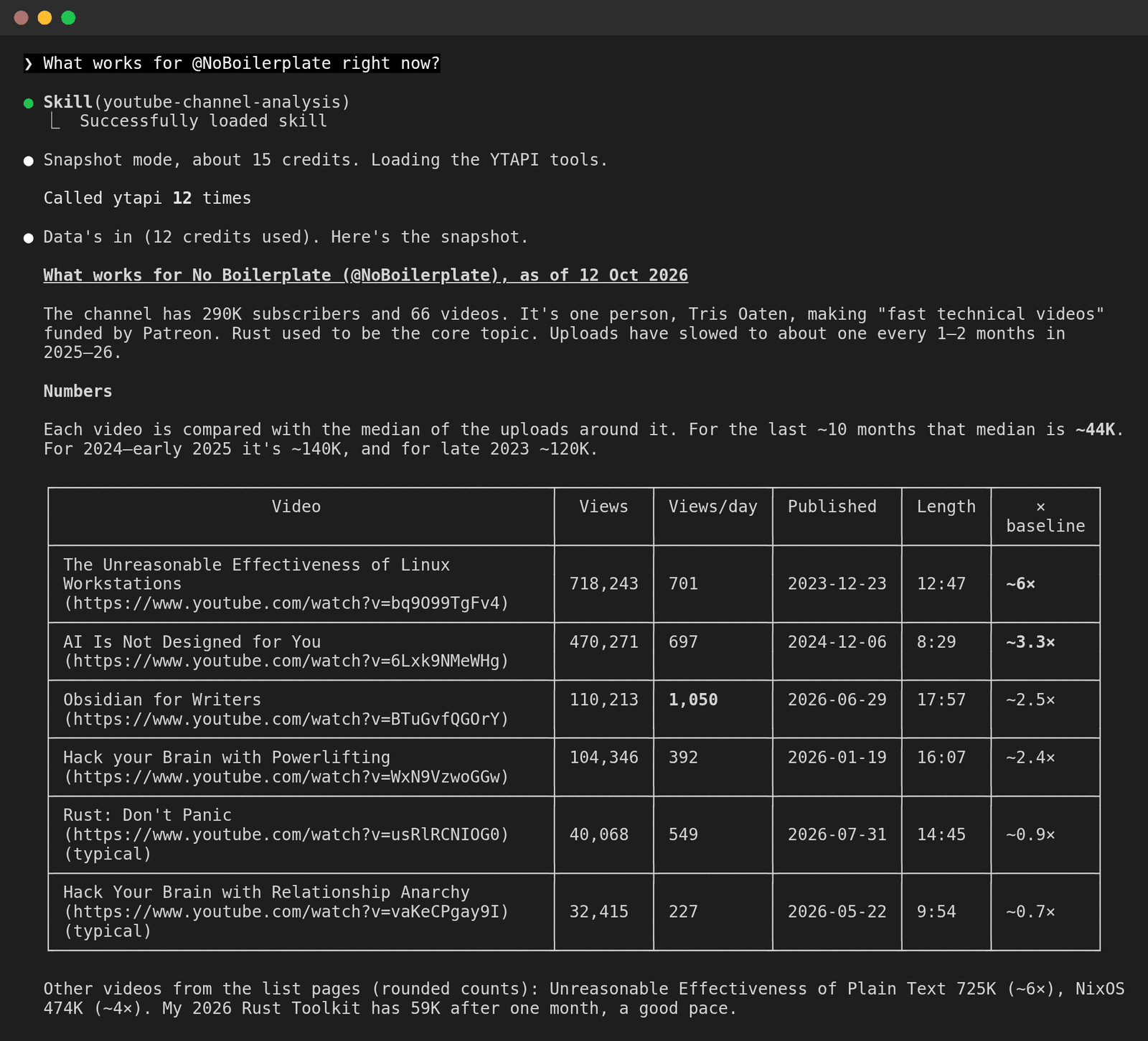
The baseline for the last ten months or so is about 44K views. Against it, two recent videos stand out:
- "Obsidian for Writers" (June 2026): 110,213 views, about 2.5×, and the best views per day of anything recent.
- "Hack your Brain with Powerlifting" (January 2026): 104,346 views, about 2.4×.
The finding we found most useful was a counterexample. "Hack Your Brain with Relationship Anarchy" (May 2026) uses the same title frame as the channel's two biggest videos ("Hack your brain with Obsidian.md", 2.2M, and "Hack Your Brain with Polyphasic Sleep", 1.3M), and got 32,415 views, about 0.7×. An older one, "Hack your brain with soylent", has 68K. The agent's reading: the frame works when it fixes a problem the audience already has, such as memory or back pain from desk work, and it doesn't carry a topic on its own. A title formula copied without that context would have missed it.
Our first version of the skill got the baseline wrong. It took the median of the whole newest page. On a channel that posts this rarely, one page covers three years, and older videos have had years to collect views, so the median came out near 100K and neither recent breakout stood out. The skill now compares each video with uploads from around the same time.
2. Growth story: how the channel took off
"How did @NoBoilerplate take off?" Sorted oldest first, the uploads tell a clear story:
- January 2018: "Clojure: Turtles All The Way Down", a 3:53 slide talk, and one more like it. Both have about 21,000 views today. Then nothing for four years.
- May 25, 2022: "Rust makes you feel like a GENIUS", the first video in a new format: about ten minutes, fast, with the claim in the first ten seconds. 439,118 views and a 4.57% like rate.
- June 30, 2022: "Rust for the impatient", the earliest upload that has more than a million views today (1,015,088).
- May and July 2023: "Hack Your Brain with Polyphasic Sleep" (1,388,428) and "Hack your brain with Obsidian.md" (2,244,992, the biggest so far). The same format, applied to problems far more people have than Rust developers.
Announcements and side projects in between (a Patreon announcement, a podcast promo, a mentoring offer) stayed between 4,000 and 15,000 views, while most Rust videos from the same months drew roughly 80,000 to 440,000. The agent's lesson for a new channel: the same person was stuck at about 21K with slide talks and broke out on the first video after changing the format, so settle the format before worrying about the back catalog.
Views on old videos keep growing for years, so this shows what lasted, not how each video did in its first week. Subscriber history isn't public, and the agent said so instead of drawing a growth curve.
3. Breakout teardown: Obsidian for Writers
"Why did Obsidian for Writers do so well? Do a teardown." The video details gave 110,213 views in 104 days, about 1,050 a day. Likes are 3.4% of views and comments 0.27% (293), against 5.8 to 6.8% and 0.6 to 1.3% on the channel's other recent videos. The agent read that as a sign the video reached many people who don't already watch the channel, then looked for more evidence: the video is co-written with Bob Doto, author of a book on writing; YouTube recommends writing-tool videos next to it, alongside its usual programming ones; and in a YouTube search for its title it came second. Traffic sources are private, so this stays an inference.
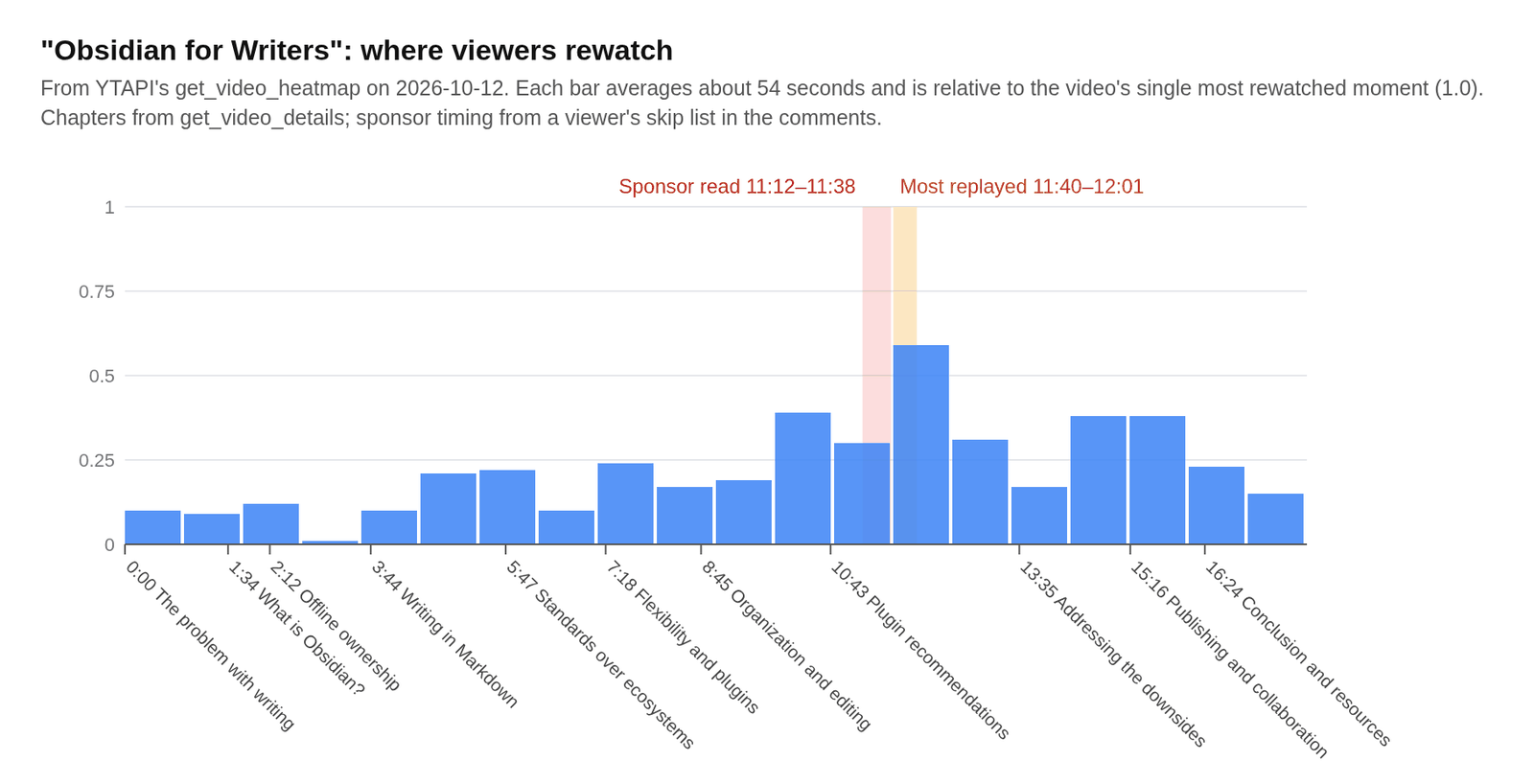
The most replayed moment is 11:40 to 12:01 (watch at 11:40), inside "Plugin recommendations", where the video lists specific plugins with a line on each. Here the agent caught something we would have missed. A sponsor read ends just before it: one of the top comments lists the stretches to skip, including 11:12 to 11:38. So part of the peak is viewers landing where the content resumes, and part may be people rewinding a list of names to write them down. The graph can't separate the two, and the agent said so rather than calling it the best part of the video.
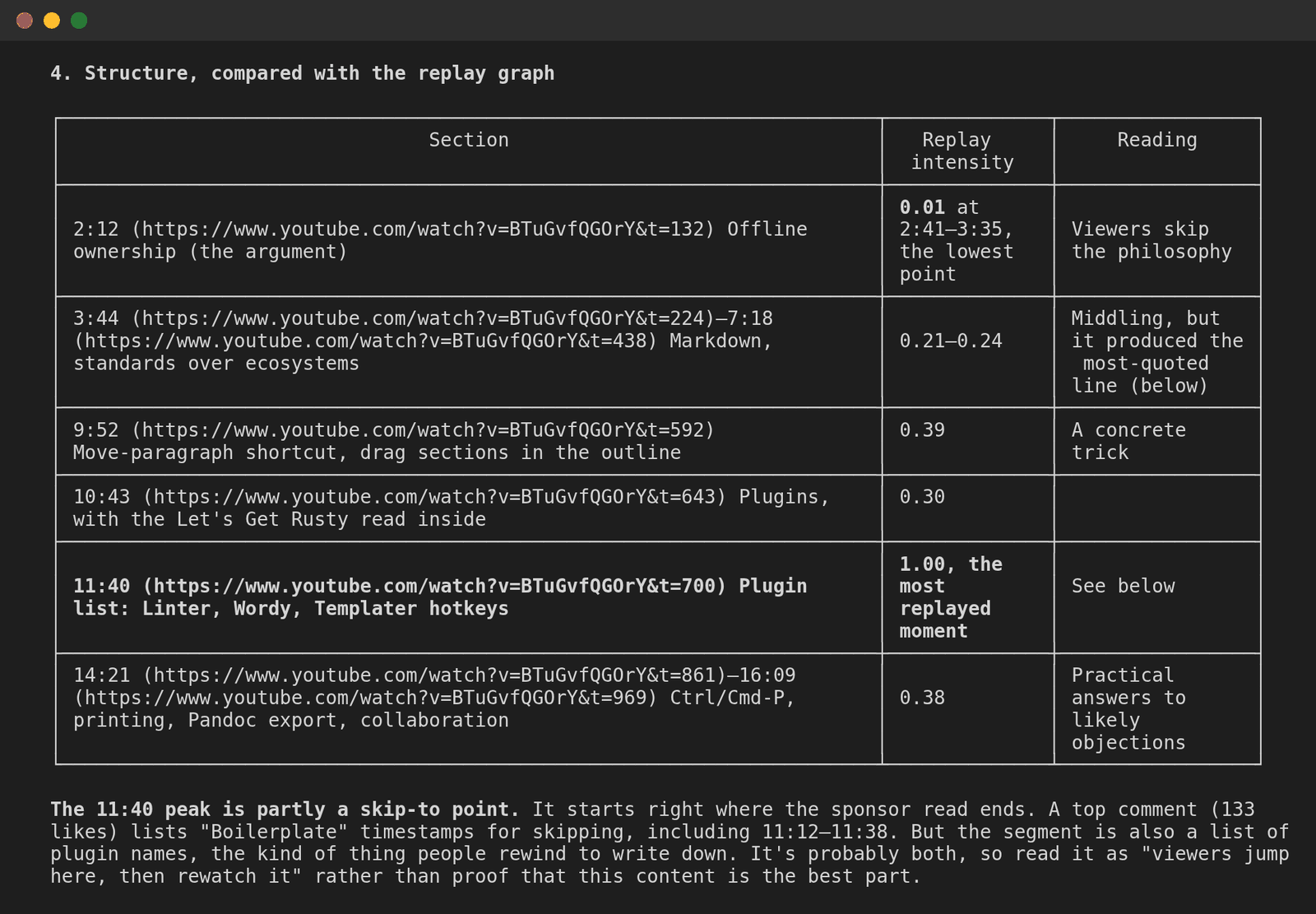
The rest of the graph is easier to read. The quietest stretch, 2:41 to 3:35, is in "Offline ownership", the video's argument for keeping files on your own disk. The higher stretches outside the peak are practical: a keyboard shortcut for moving paragraphs around 9:52, and the command palette, printing and export section around 14:21 to 16:09. Yet the most-liked comment (468 likes) is about the argument: it finds it striking that whole generations now need local files explained to them. Viewers seem to have skipped the argument, yet it's what they talked about most.
4. The playbook
"Write the playbook. I'm starting a channel about note-taking tools." The agent wrote a SKILL.md with eleven rules, title formulas with blanks, opening templates, a structure table, a checklist and a list of don'ts, each rule with the videos and numbers behind it. An excerpt:
---
name: note-taking-playbook
description: Playbook for a YouTube channel about note-taking tools
  (Obsidian, Logseq, plain text, PKM, Zettelkasten and similar). Use when
  planning, picking topics for, titling, scripting or reviewing a video
  for this channel, or deciding what to make next.
---

## Rules
...
2. **Pitch a tool as the fix for a problem everyone has, not as software.**
   The biggest hits were about a life problem solved systematically:
   "Hack your brain with Obsidian.md" 2.2M (~15× its neighbours), polyphasic
   sleep 1.3M (~9×). A same-named video with a weak problem (soylent) got 68K.
3. **"[Tool] for [audience]" opens new audiences.** Aim one video at a group
   outside your subscribers (writers, students, researchers, game masters).
   Evidence: "Obsidian for Writers" did ~2.5× baseline with the best views/day
   in a year (1,050), ranked #2 in search for its title, and YouTube placed it
   next to writing channels.

## Title formulas
- `[Tool] for [Audience]`, which matches searches (e.g. *___ for Students*, *___ for PhD Research*)
- `I Used [Method] for [Time Period]`, a personal experiment

## Don't
- Don't make announcement or promo videos (studied channel: 4K–15K, the lowest
  of all). Promote side projects inside normal videos.
Read a generated playbook before you use it. Most of this one held up when we checked it against the data, but two rules lean on a single example. One says to put the sponsor read right before your best section so skippers land on it, which comes from the one ambiguous peak above. Another says a series loses half its views with each part, from one three-part series. We would keep both as things to test, not rules. Rule 3 also says YouTube placed the video next to writing channels; the related list we saw mixes writing tools with the channel's usual programming videos. We have since changed the skill so that a pattern seen in only one video goes into a separate "To test" list instead of the rules. The playbook tells you its sources and date, which makes that check quick, and it describes a method: it doesn't copy the channel's scripts or titles, and the skill tells the agent not to.
What it cost
The four questions used 23 credits:
- the snapshot 12: the profile, two pages of uploads, six video details and three transcripts;
- the teardown 3: the most replayed graph, a page of comments and a search;
- the growth story 8: two pages of oldest uploads, five video details and one transcript;
- the playbook nothing, since it only writes.
The agent's own tally said 24. It counted the rest of a transcript it had already started, and later pages of a transcript are free. With the smallest credit pack ($9 for 2,000 credits), 23 credits is about 10 cents. A snapshot of three competitors is around 40 to 45 credits. Errors are free, such as a video without a most replayed graph.
Limits
- You need to know the channels. The agent studies channels you name. It doesn't have an index of millions of outlier videos to search by niche, which is where tools like 1of10 and OutlierKit are strong. You can ask it to search YouTube for a topic first, but that is a search, not an outlier database.
- List pages round views and give relative ages ("104K views", "8 months ago"). The agent uses exact numbers from the video details for the videos it focuses on.
- The most replayed graph is relative and isn't retention. It shows where viewers rewatch or jump to, compared with the video's own peak. Many smaller videos don't have one.
- The uploads list covers regular videos. Shorts and live streams aren't in it.
- It's a snapshot. Run it again in a few months and the numbers will have moved; the playbook records its date so you know when to refresh it.
FAQ
Is this a replacement for vidIQ or 1of10?
For studying specific channels in depth, it can be. For discovering outliers across a whole niche, keyword volumes or subscriber history, those tools have data an agent with public pages doesn't. Some people will use both: a SaaS to find the channels, an agent to take them apart.
Does it work with ChatGPT, Codex or Cursor?
The standalone skill works with any agent that reads Agent Skills and can run curl. The YTAPI MCP server works with clients that support remote MCP servers. See the setup docs.
Can it read my own channel's analytics?
No. It sees what any viewer sees. Your CTR, retention and traffic sources are in YouTube Studio.
Is it allowed to use a creator's transcript like this?
The skill reads transcripts and comments to analyze them, quotes only short lines, and writes your playbook as a method in your own words. Don't republish a channel's scripts or copy its titles and branding.
Published October 12, 2026, with numbers from a run the same day.